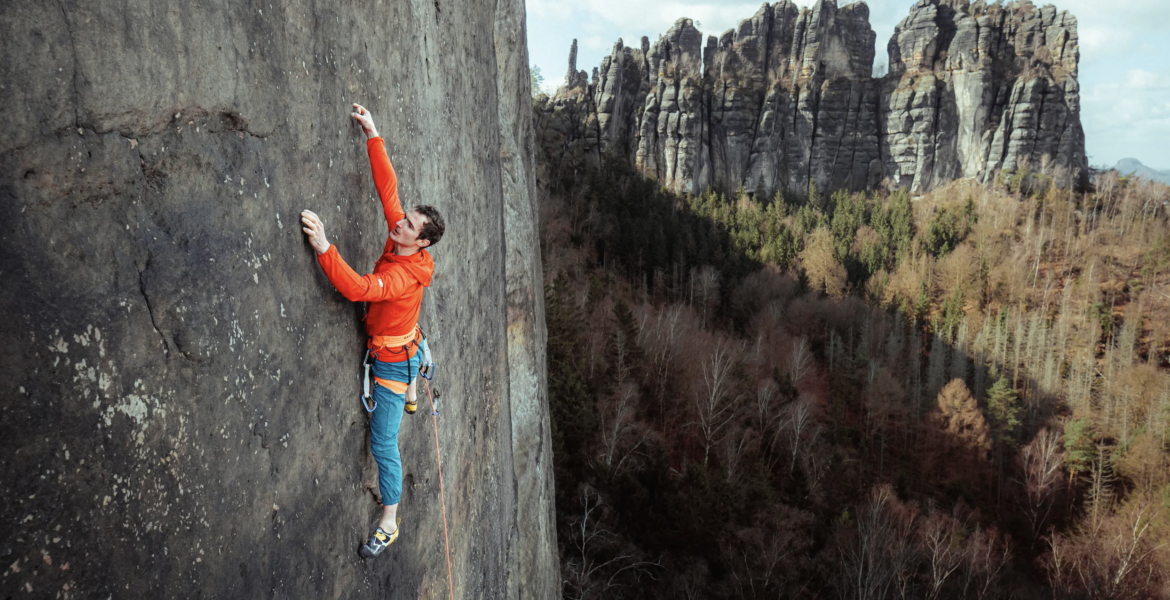
Je ne sais pas vous, mais à Fanatic on aime l’histoire de l’escalade. Adam Ondra, le plus caméléon des mutants, vient de gratifier la gente varappeuse d’une vidéo bien léchée sur les tours de grès de Saxe, au-dessus de la rivière Elbe, dans laquelle il répète des voies historiques tout en mettant en avant les premiers ascensionnistes. À commencer par Herbert Richter, actif entre 1950 et les années 70, qui ouvrit en 1960 un 7a (ou VIIIc en cotation GDR) à la mode Charles Albert, nus pieds, qu’Ondra s’applique à comprendre. Dans ses confidences face caméra, on ne peut que reconnaitre la flamme dans les yeux de Richter alors qu’il se remémore les mouvements, les mains pleines de souvenirs, ainsi que des chaussettes dont on pourrait presque jurer qu’il les martyrise avec de bien sauvages crochets de talon…
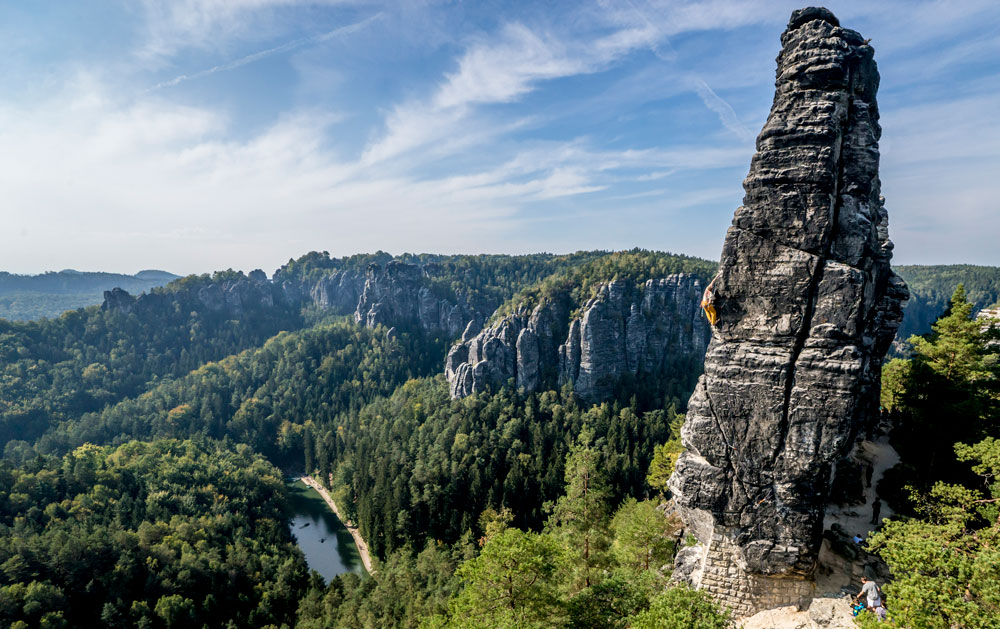
Pour rappel, ces tours de grès, que l’on trouve également de l’autre côté de la frontière en Tchéquie, en plus d’offrir des ambiances nonpareilles, imposent une éthique de grimpe über exigeante: ouverture à vue et du bas (d’où de généreuses distances entre les points, quand il y en a), escalade sans magnésie, interdiction de tout métal pour protéger les lignes.
Ondra a toujours proféré sa grande tendresse pour les tours tchèques, pourtant il s’agit ici de sa première incartade sur leurs homologues allemandes. Après les années 60, place à Bernd Arnold, la référence des années 80, avec un 7c+ ouvert là aussi pieds nus commençant par une longue cheminée sans aucun point. Une fois extirpé, s’ensuit une escalade ultra technique et fine sur une paroi verticale comme un i. Comme l’avoue Ondra, il y a les 7c+ sur calcaire espagnol, et il y a les 7c+ de Bernd Arnold.
Forward to les années 2000-20, terrain de jeu de Robert Leistner. Ondra affronte la pièce de résistance de ce quasi documentaire, ‘Die Vertreibung der letzten Idealisten’, 8c, ou XIIa en GDR. À ce sujet, vous remarquerez deux cotations pour certaines voies. Il s’agit d’abord de la cotation donnée pour l’ascension de type ‘alles frei’, où le repos à chaque point est permis, et ensuite de la cotation en libre, sans repos et en mode rotpunkt (RP), après travail donc. La voie en question a ainsi été ouverte en 2005 par Leistner, puis gravie en libre par ses soins en 2019. Plus que les chutes, on retiendra surtout le bonheur de Ondra sur une ligne que clairement il trouve sublime.
En parlant de ligne sublime… La vidéo finit sur une première visite dans un possible 9a. Affaire à suivre. Histoire à venir. Un jour, ce sera un Ondra octogénaire et en chaussettes trouées que le mutant des années 2070 viendra interviewer. La boucle se bouclera. Encore et encore. Vive l’histoire.
Photos de Mammut et Robert Leistner
I don’t know about you, but here at Fanatic we love climbing history. Adam Ondra, the most versatile of all climbers, has just treated the climbing community to a beautifully produced video set against the sandstone towers of Saxony, overlooking the River Elbe, in which he repeats historic routes whilst paying tribute to the first ascentionnists. Starting with Herbert Richter, active between 1950 and the 1970s, who in 1960 opened a 7a (or VIIIc on the GDR grading scale) in the style of Charles Albert, barefoot, which Ondra is keen to decipher. In his on-camera reflections, it is touching to noice one cannot mistake the fire in Richter’s eyes as he recalls the moves, his hands full of memories, as well as his socks—which one could almost swear he is tormenting with some rather savage heel hooks…
As a reminder, these sandstone towers, which can also be found across the border in the Czech Republic, not only offer an unrivalled atmosphere but also demand an extremely rigorous climbing ethic: on-sight and ground-up ascents (hence the generous run-outs, where rings do even exist), climbing without chalk, and a ban on any metal for protection.
Ondra has always professed his great affection for the Czech towers, yet this marks his first foray onto their German counterparts. Following the 1960s, the spotlight turns to Bernd Arnold, the benchmark of the 1980s, with a 7c+ route also opened barefoot, beginning with a solo up a long chimney. Once out of the chimney, ultra-technical and delicate climbing follows on a wall as vertical as an ‘i’. As Ondra admits, there are 7c+ routes on Spanish limestone, and then there are Bernd Arnold’s 7c+ routes.
Fast forward to the 2000–20s, Robert Leistner’s playground. Ondra tackles the pièce de résistance of this quasi-documentary, ‘Die Vertreibung der letzten Idealisten’, 8c, or XIIa in the GDR. On this subject, you’ll notice two grades for certain routes. The first is the grade given for an ‘alles frei’ ascent, where resting at each ring is permitted, and the second is the free climbing grade, without resting and in rotpunkt (RP), i.e. redpoint mode. The route in question was first opened in 2005 by Leistner, and then free-climbed by him in 2019. More than the falls, what stands out is Ondra’s sheer joy on a route that he clearly finds sublime.
Speaking of sublime lines… The video ends with a foretaste at a potential 9a. Watch this space. A story to come. One day, it will be an octogenarian Ondra, wearing socks with holes in them, whom the mutant from the 2070s will come to interview. The circle will be complete. Again and again. Long live history.
Pictures by Mammut and Robert Leistner