Sensation en Ariège ! Le bloqueur toulousain Rémi Duboz vient de réaliser une belle croix avec la première ascension de « La part des anges » sur le site de bloc de Laramade en vallée d’Auzat-Vicdessos. Estimée à 8C, c’est tout simplement la proposition la plus difficile en bloc des Pyrénées, et une proposition de haut-niveau en bloc dans le Sud-Ouest de la France ! Retour avec Rémi qui nous en dit plus sur cette réalisation.
– Peux-tu te présenter brièvement ?
J’ai 33 ans dont 25 ans de grimpe dans les poulies.
Originaire de Franche-Comté, je me suis très vite passionné pour l’escalade sous différentes formes : falaise, grandes voies, compétition…
J’ai ensuite migré à Toulouse pour mes études. Je savais qu’il y avait ici une vraie dynamique autour du bloc, et j’avais envie et besoin d’aller dans cette direction. J’ai beaucoup progressé en bloc, d’abord en compétition puis en extérieur, notamment en découvrant les spots pyrénéens.
Je crois m’être toujours posé énormément de questions quant à la progression et à la performance en escalade : la justesse du mouvement, son efficience. Assez naturellement, je me suis tourné vers l’entraînement, le coaching et l’ouverture.
J’ai travaillé 6 ans pour la Ligue Occitanie, avec notamment pour mission le développement du Pôle Espoir et une forte envie de transmettre. Aujourd’hui, je travaille comme ouvreur et coach/entraîneur. Et sur mon temps libre, j’essaie d’être le plus possible dehors : grimper, explorer, rider, rouler…
– Tu présentes le bloc comme LE projet de Laramade, comment en as tu entendu parler, qui avait commencé à essayer, quelle est l’histoire du bloc ?
Je crois que ma toute première session de bloc dans les Pyrénées s’est faite à Laramade. Ce petit spot de granite, sans véritable topo, à environ 1h15 de Toulouse. En demandant quelques infos sur le site auprès de mes nouveaux collègues de grimpe en salle, on m’a tout de suite parlé du fameux « Projet de Laramade ».
Je ne sais pas vraiment si quelqu’un travaillait déjà le bloc à l’époque, mais pour moi, il était à la fois inimaginable et mystérieux. J’ai vu ce gros dévers… et j’ai passé mon chemin. Au fil des années, tandis que je grimpais plutôt à Targasonne, j’ai entendu dire que des Toulousains s’étaient attelés au projet.
« Il paraît que ça marche »,
« Il paraît qu’un gars est tombé vers la fin »,
« Y a une contre-pointe mutante à tenir »,
« La pince est ignoble »…
La légende !
En 2020, Benjamin Nicolas, alias P’ti Ben — un grimpeur aussi fort que discret, ayant grandi à Toulouse avec le projet de Laramade comme un mythe — est passé tout proche de faire la croix, chutant sur la fin du bloc après un gros investissement.
Ayant bien progressé au cours des dernières années, je me suis dit qu’il était temps d’y mettre ma première séance. Quel échec ce fut alors !!
– Peux-tu décrire le passage, style, nombre de mouvements, où se situe le crux, en quoi consistent les principales difficultés ?
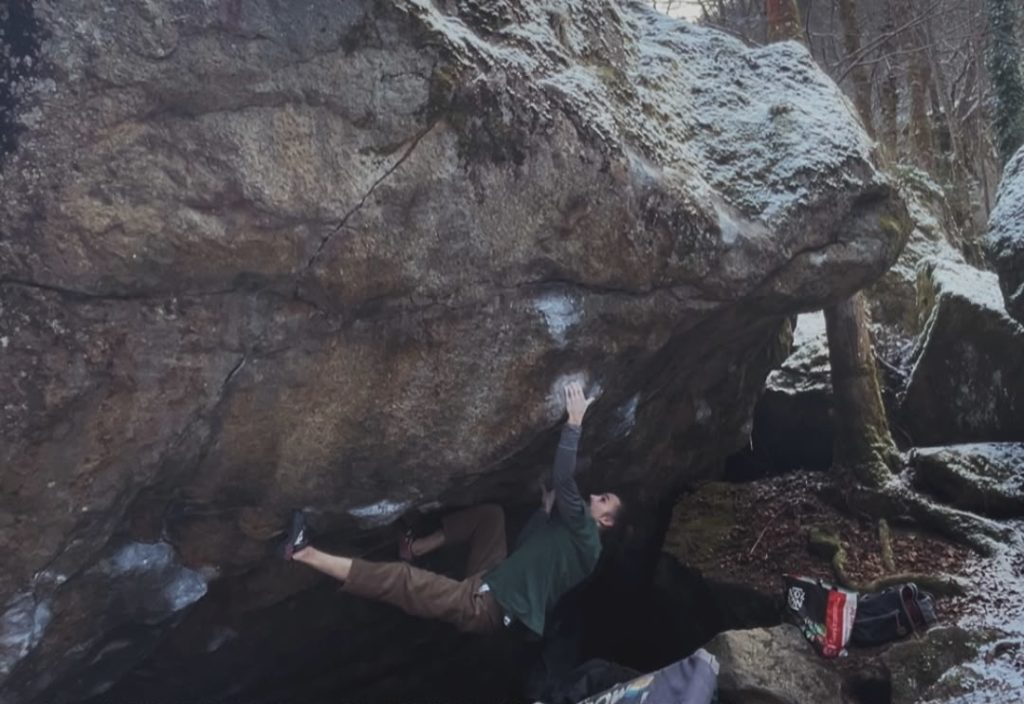
Le bloc se compose d’une dizaine de mouvements qui remontent un gros dévers vers la droite, pour rejoindre un réta final en 6A/B.
L’effort est très physique et continu, presque de plus en plus difficile, un peu étouffant !
Les 4 ou 5 premiers mouvements sont à calage, avec un talon haut au-dessus du corps, à bien maîtriser en gainage, puis une grosse pince à démonter. Vient ensuite le fameux mouvement de contre-pointe, suivi de deux mouvements très physiques pour rejoindre la seule arquée du bloc, avant d’envoyer un grand mouvement vers le plat du réta, toujours avec un gros gainage.
– Comment s’est passé le processus de travail ? les progrès ? Combien de temps as-tu mis au final ?
Cela faisait un moment que j’avais en tête de retourner voir ce bloc. L’un des principaux crux, ce sont les conditions : trop chaud en été, très humide en automne, enneigé en hiver… Peut-être un créneau au printemps. Mais j’avais en tête que P’ti Ben essayait le bloc par conditions très froides. Alors pourquoi pas l’hiver ?
Pour avoir une chance de cocher le bloc dans de bonnes conditions, il fallait le travailler dans des conditions… disons difficiles. Il m’a fallu une dizaine de sessions depuis la fin du printemps dernier : affronter la chaleur, l’humidité, les tiques…! Passage obligé pour comprendre et intégrer les mouvements et l’effort (les tiques c’était pas obligatoire mais elles étaient là!).
Je n’avais aucune méthode au départ. Il a fallu tout décrypter, m’adapter, être efficient. Ça a été un super process, avec des hauts et des bas, jusqu’au dernier moment. Fin novembre, j’ai enfin pu faire une première session dans de bonnes conditions et bien avancer dans le bloc, tout proche de l’arquée avant le « dernier mouvement dur ». De très bon augure. Mais la météo n’était pas de mon côté.
Jusqu’au Nouvel An où, entre deux morceaux de raclette, j’ai vu un créneau se dessiner le 5 janvier, avec des températures annoncées entre -2° et -8°… le rêve ! Un bon échauffement, deux essais où je tombe au dernier mouvement pour rejoindre le plat, puis un essai de folie : tout déroule, je tiens enfin le plat, je suis à la sortie du bloc, sur le réta en 6A et… je tombe ! Je rentre donc chez moi avec un sentiment très partagé, mais bien décidé à revenir le lendemain. Dernier créneau météo avant peut-être l’année prochaine… dommage que je n’aie pas la marge pour faire le bloc hors condis !
Le lendemain, j’y retourne avec beaucoup d’envie, de concentration et, pour une fois, une vraie confiance. J’avais l’impression d’avoir déjà fait le bloc. Je pouvais le refaire. Et c’est exactement ce qui s’est passé, sans m’effondrer au réta, et sans manger la neige qui m’attendait en haut ! C’était une petite libération, sans vraiment me rendre compte de ce qui s’était passé et réellement comme une impression de seconde ascension !
– Un mot sur le niveau, qu’est ce qui t’a poussé à proposer 8C ? Tu as réalisé « Au revoir » (ndlr : 8B+/C) à Targasonne, c’est un cran au dessus ?
Je n’ai pas une énorme expérience à ce niveau, mais par rapport à ce que j’ai pu essayer ailleurs — en Afrique du Sud, en Suisse, en Espagne — il me semble légitime de proposer cette cotation.
Donner une première cotation est toujours délicat, surtout quand tu passes beaucoup de temps seul sur un bloc à tout déchiffrer et intégrer. Tu peux facilement te perdre : un jour penser que le bloc est bien plus dur, puis, une fois enchaîné, te dire que finalement non.
Nul doute que le bloc sera répété à l’avenir, au vu de talents comme Thomas Lemagner ou Noé Moutault, qui s’y sont déjà un peu frottés. On verra ce qu’en penseront les répétiteurs. Et si ça donne envie à d’autres grimpeurs d’essayer, tant mieux !
Comparer avec « Au Revoir » ou, plus largement, avec les blocs durs de Targasonne est compliqué, car on est sur des styles et des efforts très différents. Mon ressenti, c’est que c’est le bloc le plus dur que j’ai réalisé dans ce registre d’effort. Et si j’avais proposé moins que 8C, les copains m’auraient gentiment tapé sur les doigts !
– Tu as ouvert pas mal de lignes ces derniers temps, notamment à Targasonne. Parle-nous de ta passion pour l’ouverture de nouveaux blocs ou jeux.
J’ai effectivement pas mal traîné à Targasonne, où il restait quelques lignes difficiles à libérer, connues du grand public ou non. Ce n’est pas forcément moi qui ai découvert ces lignes, mais j’ai souvent été celui qui y a mis les premières forces.
J’aime vraiment le processus de découverte des mouvements, l’optimisation des placements et des sections, et l’engagement que demande ce travail.
J’ai encore un ou deux blocs en tête dans le Sud-Ouest que j’aimerais cocher. Mais j’ai aussi envie d’aller voir d’autres spots prochainement, pour me confronter à des blocs dont les cotations sont « confirmées ».
Pour finir, un grand merci aux ouvreurs, aux brosseurs, et surtout aux copains rencontrés au cours des 25 dernières années, qui font le grimpeur épanoui que je suis aujourd’hui.
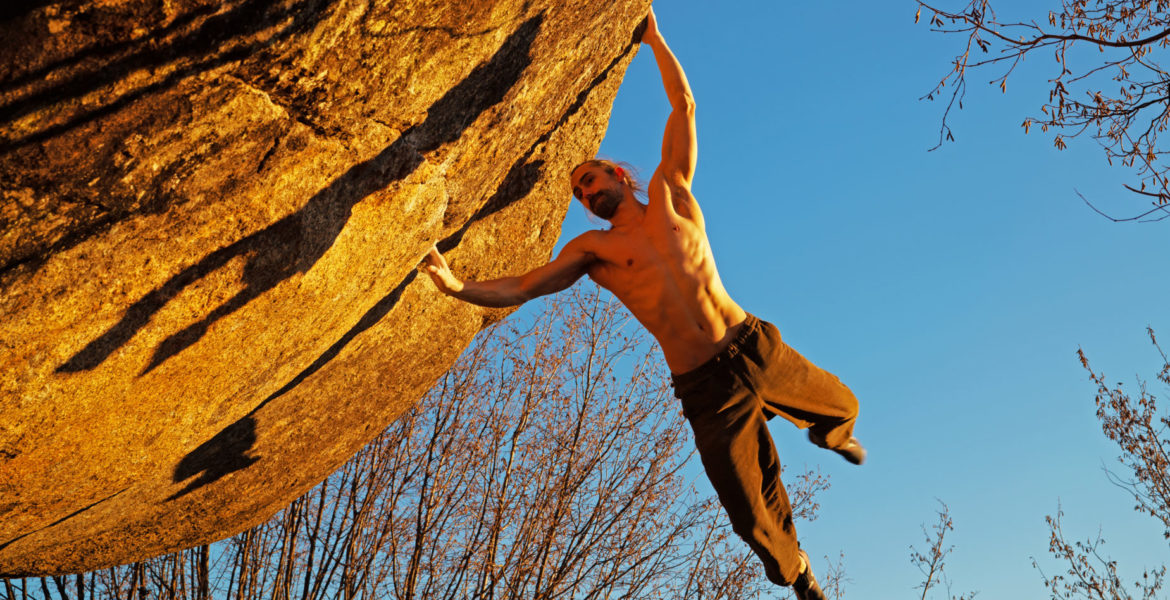
Photo de couverture : Clément Borderies
Le topo d’une partie des blocs ici (maj Novembre 2025)
Sensational news coming from Ariège, France! Toulouse boulderer Rémi Duboz has just completed a remarkable feat with the first ascent of “La part des anges” at Laramade, located in the Auzat-Vicdessos valley. Proposed 8C, it is quite simply the most difficult boulder problem in the Pyrenees, and a high-level boulder problem in southwestern France! We catch up with Rémi, who tells us more about this send.
– Can you briefly introduce yourself?
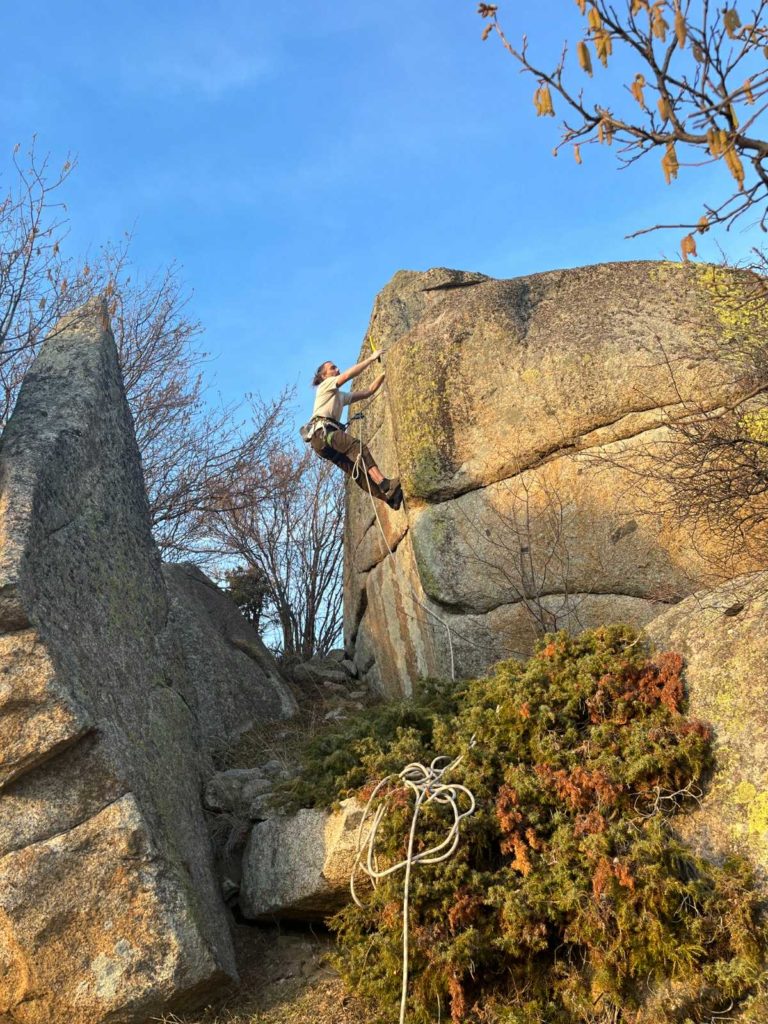
I’m 33 years old and have been climbing for 25 years. Originally from Franche-Comté, I quickly became passionate about climbing in all its forms: rockclimbing, multi-pitch climbing, competition climbing, etc.
I then moved to Toulouse for my studies. I knew there was a real buzz around bouldering here, and I wanted and needed to go in that direction. I made a lot of progress in bouldering, first in competition and then outdoors, particularly when I discovered some places in the Pyrenees.
I think I’ve always asked myself a lot of questions about progress and performance in climbing: the accuracy of the movement, its efficiency. Quite naturally, I turned to training, coaching, and route setting.
I worked for the Occitanie League for six years, with a particular focus on developing the young team and a strong desire to pass on my knowledge. Today, I work as a route setter and coach/trainer. And in my free time, I try to be outdoors as much as possible: climbing, exploring, riding, cycling…
– You present the boulder as THE Laramade project. How did you hear about it, who started trying it, and what is the history of the boulder?
I think my very first bouldering session in the Pyrenees was in Laramade. It’s a small granite place, with no real guidebook, about an hour and fifteen minutes from Toulouse. When I asked my new climbing buddies at the gym for some info about the site, they immediately told me about the famous “Laramade Project.”
I don’t really know if anyone was already working on the boulder at the time, but for me, it was both unimaginable and mysterious. I saw that big overhang… and moved on. Over the years, while I was climbing mainly in Targasonne, I heard that some people from Toulouse had taken on the project.
“Apparently it works,”
“Apparently a guy fell towards the end,”
“There’s a mutant toehook to hold,”
“The pinch is awful”…
Legend!
In 2020, Benjamin Nicolas, aka P’ti Ben—a climber as strong as he is discreet, who grew up in Toulouse with the Laramade project as a myth—came very close to making the send, falling at the end of the boulder after a big effort.
Having made good progress over the last few years, I decided it was time to give it my first shot. What a failure it was!
– Can you describe the passage, style, number of moves, the crux, the main difficulties?
The boulder consists of about ten moves that climb up a large overhang to the right, ending with a final 6A/B mantle.
The effort is very physical and continuous, becoming increasingly difficult, and a bit suffocating!
The first 4 or 5 moves are wedged, with a high heel above the body, which requires good core strength, followed by a big pinch to hold. Next comes the famous toe hook move, followed by two very physical moves to reach the only crimp in the boulder, before sending a big move towards the sloper of the top, still requiring a lot of core strength.
– How did the process go? How did you progress? How long did it take you in the end?
I had been thinking about going back to try this boulder for a while. One of the main challenges is the conditions: too hot in summer, very humid in fall, snowy in winter… Maybe spring would be a good time. But I remembered that P’ti Ben tried the boulder in very cold conditions. So why not winter?
To have a chance of checking off the boulder in good conditions, I had to work on it in… let’s say difficult conditions. It took me about ten sessions since the end of last spring: battling the heat, humidity, ticks…! It was a necessary step to understand and integrate the movements and the effort (the ticks weren’t necessary, but they were there!).
I had no method at the beginning. I had to figure everything out, adapt, and be efficient. It was a great process, with ups and downs, right up until the last moment. At the end of November, I was finally able to do my first session in good conditions and make good progress on the boulder, getting very close to the crimp before the “last difficult move.” It looked very promising. But the weather wasn’t on my side.
Until New Year’s Day, when, between two slices of raclette plate, I saw a window of opportunity opening up on January 5, with temperatures forecast between -2° and -8°… perfect! A good warm-up, two attempts where I fell on the last move to reach the sloper, then a crazy attempt: everything went well, I finally reached the sloper of the mantle, I was at the end of the boulder, on the 6A part and… I fell! So I went home with mixed feelings, but determined to come back the next day. This was the last weather window before perhaps next year… too bad I didn’t have the margin to do the boulder out of condition!
The next day, I returned with a lot of desire, concentration, and, for once, real confidence. I felt like I had already done the boulder. I could do it again. And that’s exactly what happened, without falling on the hold and without eating the snow that was waiting for me at the top! It was a small release, without really realizing what had happened and really feeling like a second ascent!
– A word about the grade, what made you suggest 8C? You did « Au revoir » (8B+/C) in Targasonne, is this one notch above?
I don’t have a lot of experience at this level, but compared to what I’ve tried elsewhere—in South Africa, Switzerland, Spain—it seems legitimate to suggest this grade.
Giving an initial grade is always tricky, especially when you spend a lot of time alone on a boulder, figuring everything out and getting the hang of it. It’s easy to get confused: one day you think the boulder is much harder, then once you’ve climbed it, you realize that’s not the case.
There’s no doubt that the boulder will be repeated in the future, given the talent of climbers like Thomas Lemagner and Noé Moutault, who have already had a go at it. We’ll see what the repeaters think. And if it makes other climbers want to try it, so much the better!
Comparing it to “Au Revoir” or, more broadly, to the hard boulders at Targasonne is complicated, because they are very different styles and require very different efforts. My feeling is that it’s the hardest boulder I’ve ever done in this range of effort. And if I had suggested anything less than 8C, my friends would have kindly given me a slap on the finger!
– You’ve opened quite a few routes lately, especially in Targasonne. Tell us about your passion for opening new boulders or problems.
I’ve spent quite a bit of time in Targasonne, where there were still a few difficult routes to free, some well-known and others not so much. I wasn’t necessarily the one who discovered these routes, but I was often the one who put in the initial effort.
I really enjoy the process of discovering the moves, optimizing placements and sections, and the commitment that this work requires.
I still have one or two boulders in mind in the Southwest that I’d like to check off my list. But I also want to visit other spots soon, to tackle boulders with “confirmed” grades.
Finally, a big thank you to the route setters, the brushers, and especially the friends I’ve met over the last 25 years, who have made me the fulfilled climber I am today.
Cover pic: Clément Borderies