


Aimez-vous les livres d’horreur ? Vous voyez le genre, avec un personnage principal qui mène sa barque tranquillou, pépère dans son coin, jusqu’à la rencontre du grand méchant loup. S’ensuit une longue et pénible course-poursuite dans laquelle le bonhomme qui n’a rien demandé se fait frayeur sur frayeur, perd un bras ici, là une guibolle, pour finir ––– (no spoiler).
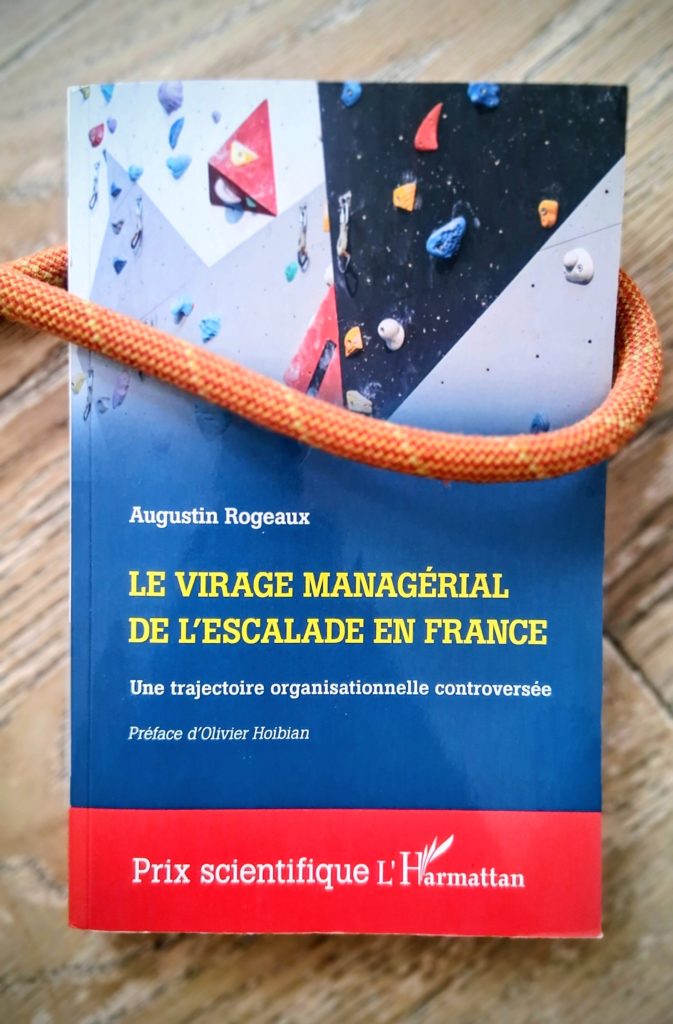
J’en ai un bon pour vous : Le virage managérial de l’escalade en France d’Augustin Rogeaux. Travail de recherche universitaire, prix scientifique L’Harmattan, ce condensé de sueurs froides raconte par le menu ce sur quoi les plus sceptiques de la communauté grimpale nous avaient mis en garde dès le passage de la gestion des compétitions de l’UIAA à l’IFSC en 2006, puis les premiers rapprochements publics entre le CIO et l’IFSC, et par ricochet les acoquinements IFSC-FFME.
On pourrait parler d’enquête pour qualifier ce tome, mais au juste on pense en fait plutôt à un rapport légiste en le lisant. Mince, on avait dit no spoiler. 4 chapitres, 4 clous dans le cercueil: 1. « L’intégration olympique de l’escalade : une innovation organisationnelle? »; 2. « La stratégique politique de la FFME : une ‘marketization extensive’ de l’organisation fédérale »; 3. « L’essor des salles privées d’escalade : une ‘marketization intensive’ du marché »; 4. « Processus d’innovations dans la gestion des sites naturels d’escalade ».
En dépit de son optique principalement française, Rogeaux parvient tout de même à montrer que ce qui se passe chez nous depuis 2006 s’ancre fermement dans la volonté de l’IFSC de se noyer dans la manne olympique. Laquelle est alors aidée par le besoin du CIO de revivifier une fan base dont les jeunes se détournent. Il faut du frisson, de la glisse, des « sports à adrénaline » n’est-ce pas. Le CIO avait sûrement besoin de l’escalade, mais l’inverse était-il vrai ?
De ce choix faustien au niveau planétaire découle en France une cascade de tours de vis, un à un, méthodiques et patients, menant par différents biais, angles et outils à ce virage managérial donnant son titre à l’ouvrage. Soyons honnête, ce n’est pas dans les grandes lignes que Rogeaux nous éclaire, car ces grandes lignes on ne les connait que trop bien : la « logique marchande », la « volatilité de l’association entre FFME et salles privées », la « MacDonaldization de l’escalade », le « processus d’économisation » etc. Par contre son livre est une véritable mine pour ce qui est de retracer les petites étapes internes et logiques institutionnelles complexes régissant l' »évolution » de l’escalade dans nos frontières. On en apprend des vertes et des pas « murs ».
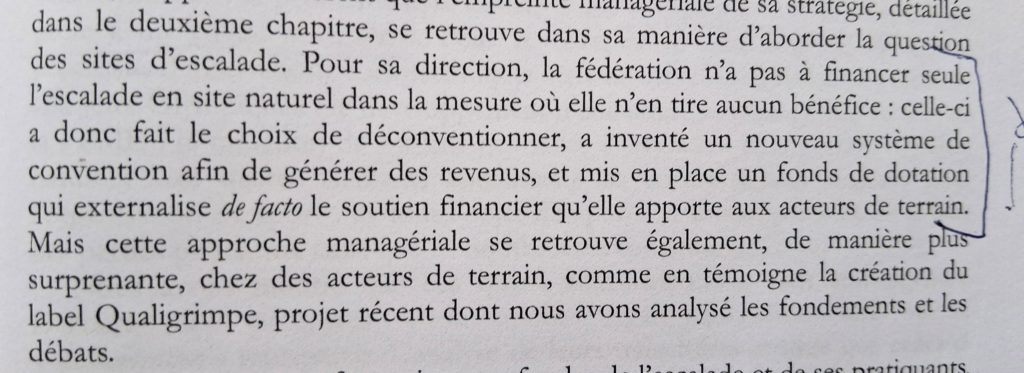
Mais je m’en voudrais de vous priver de vos propres frissons et petits cris à la lecture de cet ouvrage à ne pas mettre entre les mains des enfants. Si je peux émettre un conseil, verrouillez la porte en particulier quand vous lirez le quatrième et dernier chapitre, intitulé « Processus d’innovations dans la gestion des sites naturels d’escalade ».
Non, l’escalade n’est pas morte. Mais l’idée de l’escalade ? Marchandiser à tout va c’est bien beau, ça rapporte des pépettes et donne de l’importance à certains. Par contre toute économisation forcenée induit à sa suite, entre autres, une acculturation. Le passage d’une culture à une autre, souvent accompagné de perte de repères. Le client est roi, tout est fait pour son confort et sa satisfaction. Une armée d’ouvreurs, de nettoyeurs de prises, de balayeurs et serveurs s’active dans l’ombre pour que le roi lève le pouce en se tournant les pouces. Et tout va bien tant qu’il paie son abonnement et qu’il grimpe en plastique. Mais là où l’acculturation entraînée par le virage marchand joyeusement assumé par la FFME commence à montrer ses limites tient à la rencontre entre l’ethos « client » et la nature. Non, je ne dis pas que tous les anciens respectaient Gaia, et non je ne soutiens pas l’idée que tout grimpeur de salle saccage Bleau ou Céüse. Ceci étant le problème est culturel, et dépasse donc les cas individuels. Penser que l’argent fait tout, qu’il suffit, que seul ce qui rapporte est bon, instaure un état d’esprit dont il est difficile de s’extraire, des réflexes de pensée parfois décontextualisés n’aidant en rien le schmilblick.
Nihil novi sub sole, vous me direz : la société entière semble régie par un rapport marchand au monde et aux autres. Transactionnalisme des biens et des personnes. Je t’aime je t’achète. Je t’aime plus je te vends ou te jète.
S’il ne nous reste plus que la naïveté pour espoir, alors voici: on rêverait d’une fédé qui ne conçoive pas le capitalisme comme l’alpha et l’oméga de ce(ux) qu’elle fédère, et n’oublie pas que les JO (et les compètes) devraient rester une belle distraction plus qu’une trop grande attraction. Allez, ciao les bisounours.
Photos de Fanatic Climbing
Do you like horror books? You know the sort, with a main character who’s just minding his own business, living it up in his own little corner, until he meets the big bad wolf. What follows is a long and gruelling chase in which the poor bloke, who didn’t ask for any of this, goes through one scare after another, losing an arm here, a leg there, only to end up –– – (no spoilers).
I’ve got a good one for you: Le virage managérial de l’escalade en France by Augustin Rogeaux. An academic work, winner of the L’Harmattan scientific prize, this compendium of cold sweats recounts in minute detail what the most sceptical members of the climbing community had warned us about ever since the management of competitions passed from the UIAA to the IFSC in 2006, followed by the first public rapprochements between the IOC and the IFSC, and by extension the IFSC-FFME (French federation) collusion.
One might call this volume an investigation, but in fact, reading it, it feels more like a coroner’s report. Oops, we said no spoilers. Four chapters, four nails in the coffin: 1. “The Olympic integration of climbing: an organisational innovation?”; 2. “The FFME’s political strategy: an ‘extensive marketisation’ of the federal organisation”; 3. “The rise of private climbing centres: an ‘intensive marketisation’ of the market”; 4. “Innovation processes in the management of natural climbing sites”.
Despite his predominantly French perspective, Rogeaux nevertheless manages to show that what has been happening here since 2006 is firmly rooted in the IFSC’s desire to cash in on the Olympic windfall. This is further aided by the IOC’s need to revitalise a fan base from which young people were turning away. They needed thrills, speed, ‘adrenaline sports’, didn’t they? The IOC certainly needed climbing, but was the reverse true?
From this Faustian choice on a global scale, a cascade of tightening measures ensued in France, one by one, methodical and patient, leading through various means, angles and tools to the managerial shift that gives the book its title. Let’s be honest, it is not the broad outlines that Rogeaux sheds light on, for we know these all too well: the “market logic”, the “volatility of the partnership between the FFME and private climbing centres”, the “McDonaldisation of climbing”, the “process of economisation”, and so on. However, his book is a veritable goldmine when it comes to tracing the small internal steps and complex institutional logics governing the “evolution” of climbing within our borders.

But I wouldn’t want to deprive you of the thrills and gasps you’ll experience reading this book – which is definitely not suitable for children. If I may offer a word of advice, lock the door, especially when you get to the fourth and final chapter, entitled ‘Innovative Approaches to the Management of Natural Climbing Sites’.
No, climbing isn’t dead. But what about the spirit of climbing? Commercialising everything to the hilt is all very well; it brings in the cash and gives some people a sense of importance. However, any kind of frenzied cost-cutting/money-making inevitably leads, amongst other things, to acculturation. The transition from one culture to another, often accompanied by a loss of bearings. The customer is king; everything is done for their comfort and satisfaction. An army of route setters, hold cleaners, sweepers and waiters bustle about behind the scenes so that the king can give the thumbs-up whilst twiddling his thumbs. And all is well as long as he pays his membership fee and climbs on plastic. But where the acculturation brought about by the commercial shift—happily embraced by the FFME—begins to show its limits lies in the clash between the ‘customer’ ethos and nature. No, I’m not saying that all the old-timers respected Gaia, and no, I don’t support the idea that every indoor climber is trashing Bleau or Céüse. That said, the problem is cultural, and therefore goes beyond individual cases. Believing that money is everything, that it is enough, that only what makes a profit is good, fosters a mindset from which it is difficult to escape, with out-of-context thought patterns doing nothing to help the situation.
Nihil novi sub sole, you might say: the whole of society today seems governed by a commercial relationship with the world and with others. The commodification of goods and people. I love you, I buy you. I don’t love you anymore, I sell you or throw you away.
If all we have left to hope for is naivety, then here goes: we’d dream of a federation that doesn’t view capitalism as the be-all and end-all for those it represents, and doesn’t forget that the Olympics (and other competitions) should remain a pleasant diversion rather than an all-consuming obsession. Right then, bye-bye, Care Bears.
Pictures by Fanatic Climbing