


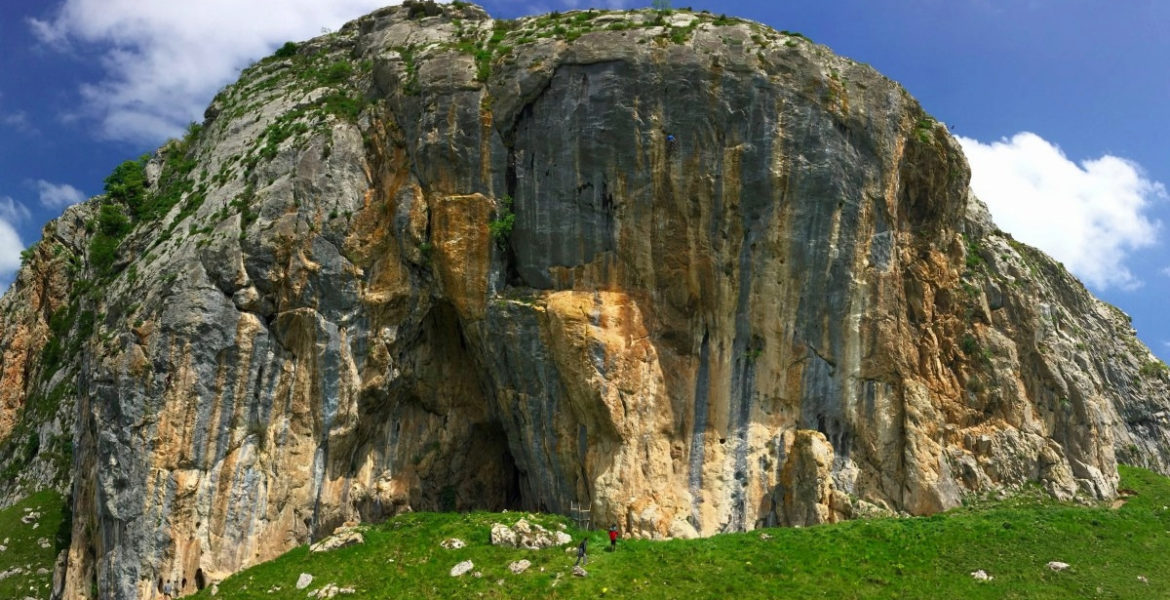
Derrière tout passage d’escalade, il y a d’abord une ligne, mais aussi des grimpeurs qui l’ont faite naître. Plongez au cœur de passages de légende avec la rubrique « Il était une voie », un état civil de ces itinéraires qui continuent de fasciner des générations et de façonner notre activité !
Behind every route there is a vision, and the climbers who made it reality. Dive into the history of legendary routes with the section “Once upon a line”, a sort of ‘Origins’ of these gems that keep on fascinating us generation after generation, and shaping our passion!
Silence vertical
Pyrénées centrales, France
Troubat
Antoine le Menestrel, 1987
Antoine le Menestrel, 1987
En 1986, la falaise de Troubat, dans les Pyrénées, accueillait le premier championnat de France d’escalade. Eh oui, à l’époque les salles de grimpe en étaient à leurs balbutiements. Lors de la réédition de l’événement l’année suivante, les organisateurs font à nouveau appel à Antoine le Menestrel pour participer à l’ouverture. Moins de place que l’année d’avant, normal, Antoine se gratte la tête mais finit par sortir au forceps (mais au perfo) 8 voies, dont la très élégante « Silence vertical ».
Éloignée du style de sa cousine plus connue « Silence », elle partage pourtant avec elle ce concept du non-bruit, qui marqua Ondra lors de sa libération du premier 9c et constitue une recherche quasi-obsessionnelle pour Le Menestrel (le mot apparait à de nombreuses reprises dans Folambule, l’autobiographie de ce dernier).
« Silence vertical », voie historique et mythique des Pyrénées mérite le détour, même si les livres d’histoire ne la retiennent que parce qu’elle fut le troisième 8b+ enchaîné par une femme, Robyn Erbesfield-Raboutou (mère de Brooke et Shawn). C’est donc pour sortir la voie des tiroirs qu’on est allé directement à la source pour en savoir plus, presque 40 ans après son ouverture.
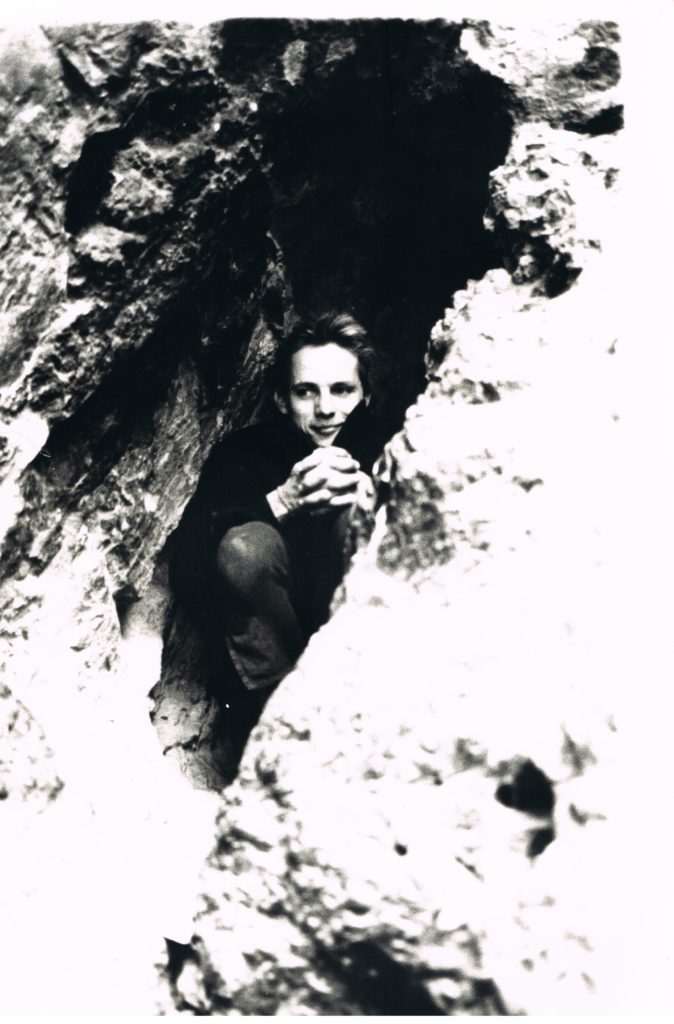
Antoine Le Menestrel au pied de « Silence vertical »
Comme à son habitude, Antoine le Menestrel ne nous a pas déçu, puisqu’il nous partage la page de ses carnets écrite à l’occasion. C’est un document littéralement historique, plein d’enseignements, de préfiguration de l’avenir et de cœur ouvert. À apprécier à sa juste valeur.
« Falaise de Troubat, Septembre 1987
Avec Serge Casteran, la figure locale de la Barousse, on ouvre les voies de la deuxième compétition. Il y a moins de possibilités d’ouverture que l’an passé. On doit ouvrir 2 voies de qualif, une demie et une finale soit 8 voies en tout. Mais il faut des voies pour sélectionner les compétiteurs et la partition minérale n’a pas de relation avec cette contrainte. C’est compliqué, je dois ouvrir en pensant à comment nous allons laisser cette belle falaise après la compétition. Plutôt que d’abimer les prises du rocher je taille des prises que l’on pourra reboucher facilement après la compétition. Il y a même un départ sur une échelle.
Je suis content de ne pas continuer ces ouvertures sur falaise. C’est ma dernière compétition sur site naturel. L’avenir de la compétition c’est le mur artificiel. La compétition est trop invasive avec le rocher et le pied de la falaise. La nature n’est pas là pour ça. Je le fais parce que l’an passé j’ai été formidablement accueilli par les habitants, les organisateurs, les élus.
À l’issue de la compétition, je suis hébergé au pied de la falaise. Mon hôte est dépressif comme moi, j’essaye de l’accompagner, je lui lis de la poésie, on parle. Je suis face à ma limite relationnelle, il se suicidera quelques mois plus tard.
Je finis et j’enchaine la voie de finale, qui deviendra « Silence Vertical » 8b/c (maintenant 8b+, ndlr). une grande voie de bas en haut comme je les aime. Je reste sur place quelques temps et j’alterne lecture, escalade, écriture.
Je me prépare au pied de la voie, chaque geste d’échauffement est calé sur ma respiration. L’escalade a déjà commencé. Mon expiration est mon cinquième point d’appui.
Je dose la préhension entre de petites prises et les baquets. Je teste la sensation de la préhension plusieurs fois, afin que mes doigts s’apprivoisent à la prise.
Je projette le placement de mon corps dans l’espace. Je suis déterminé, lorsque le mouvement est décidé il n’y a plus d’hésitation. J’écourte le temps de la séquence : Intuition-décision-exécution.
Je rêve plusieurs fois mon ascension avant de gravir la voie. Je m’imagine dans chaque mouvement de la voie, je les voie qu’ils tendent vers leur perfection. L’image du mouvement s’incruste dans mon corps.
Je tiens bon et je lâche prise.
Inspiré du Tao Te King de Lao Tseu et de Poésies Verticales de Roberto Juarroz, j’écris:
Silence Vertical
Dans le dos de chaque grimpeur il y a le vide, sans le vide, le grimpeur existe-il ?
Dans la falaise il y a des prises creuses, ces prises sont-elles un refuge pour mes doigts ?
Entre les prises il n’y a rien, le mouvement naît-il de cet espace ?
Dans mon esprit je fais le vide, mes pensées sont-elles plus pesantes que mon corps ?
N’y a-t-il pas de relation entre tous ces vides ?
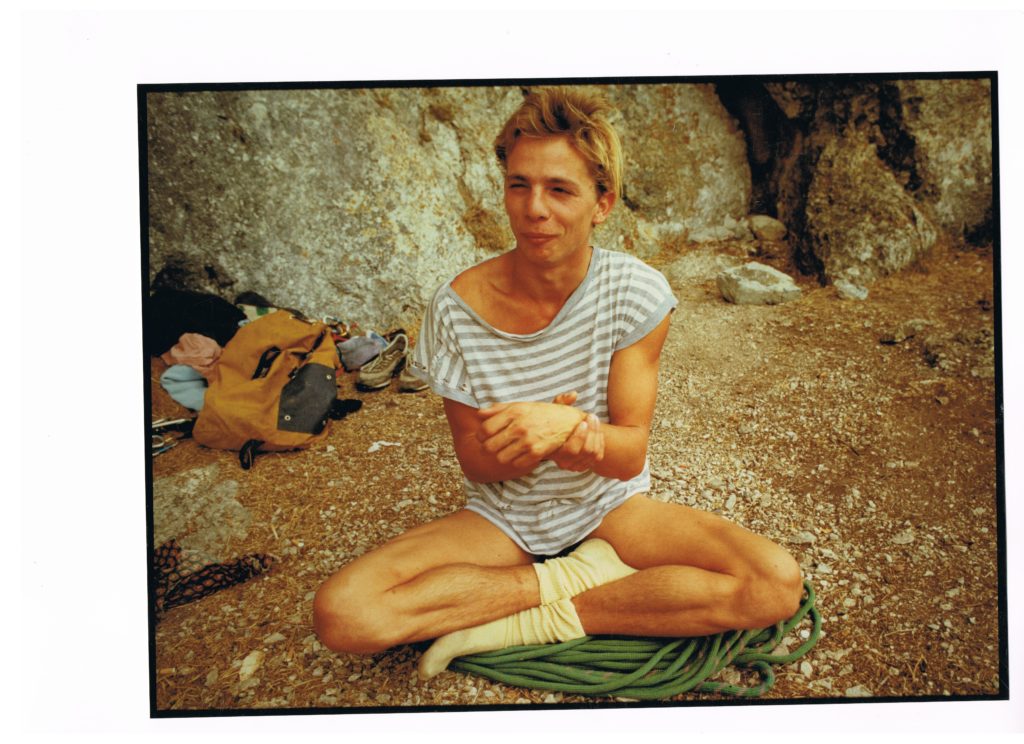
Une belle voie est donc née. Mais pas que. Folambule nous apprend en effet que Troubat 1987 aura été encore plus déterminant dans l’existence d’Antoine le Menestrel (cf Les lézards bleus): « Le soir entre la demi-finale et la finale après une soirée arrosée au brûlot, nous remontons sur le site avec toute l’équipe d’organisation. La falaise est éclairée, il y a de la musique. Je suis grisé et je grimpe, je mime les grimpeurs, Edlinger, Cortijo, JB… L’assistance rigole, dans la descente je mets la tête en bas, je fais le pitre en courant sur la paroi. Je suis heureux, j’ai du plaisir à partager ma joie. Les amis rigolent, je découvre le plaisir du jeu entre un grimpeur et des spectateurs. Je découvre la cordée émotionnelle entre le danseur et le public. C’est ma première performance improvisée. Cette expérience me séduit, je sens que je suis à ma place. »
Photos: Philippe Pousson – Photo de couverture : Mélanie Cannac
Témoignage/Account: Antoine le Menestrel
In 1986, the Troubat crag in the Pyrenees hosted the first national French climbing championship. That’s right – back then, indoor climbing centres were still in their infancy. When the event was held again the following year, the organisers once more called on Antoine le Menestrel to help open the routes. With less space than the year before – which was to be expected – Antoine scratched his head but eventually managed to bolt eight routes, including the very elegant “Silence vertical”.
Although a far cry from the style of its better-known cousin “Silence”, it nevertheless shares with it this concept of ‘no noise’, which made such an impression on Ondra when he free-climbed the first 9c and constitutes an almost obsessive pursuit for Le Menestrel (the word appears numerous times in *Folambule*, his autobiography).
“Silence vertical”, a historic and legendary route in the Pyrenees, is well worth a visit, even if the history books only mention it because it was the third 8b+ route completed by a woman, Robyn Erbesfield-Raboutou (mother of Brooke and Shawn). So, to bring this route out of obscurity, we went straight to the source to find out more, almost 40 years after it was first climbed.
As ever, Antoine le Menestrel has not disappointed us, sharing with us the page from his notebooks written for the occasion. It is a truly historic document, full of insights, glimpses into the future and heartfelt sincerity. It deserves to be appreciated for what it is.
« Troubat Cliff, September 1987
Together with Serge Casteran, the local figure from the Barousse area, we’re bolting the routes for the second competition. There is less space to set than last year. We have to set two qualifying routes, one semi-final and one final – eight routes in total. But we need routes to select the competitors, and the rock’s natural features bear no relation to this constraint. It’s tricky; I have to set the routes whilst thinking about how we’re going to leave this beautiful cliff after the competition. Rather than damaging the natural holds, I’m chiselling out holds that can be easily filled in again after the competition. There’s even a start on a ladder.
I’m glad I won’t be continuing with these route-setting projects on the rock. This is my last competition on a natural site. The future of competition lies with artificial walls. The competition is too invasive for the rock and the foot of the cliff. That’s not what nature is for. I’m doing this because last year I received a wonderful welcome from the locals, the organisers and the local councillors.
After the competition, I’m staying at the foot of the cliff. My host is depressed, just like me; I try to support him, I read him poetry, we talk. I’m coming up against my limits in this relationship; he’ll take his own life a few months later.
I finish and go on to climb the final route, which would become ‘Silence Vertical’ 8b/c (now 8b+, ed.). A top-down route, just the way I like them. I stay there for a while, alternating between reading, climbing and writing.
I prepare at the foot of the route; every warm-up movement is synchronised with my breathing. The climb has already begun. My exhalation is my fifth point of support.
I vary my grip between small holds and jugs. I test the feel of the grip several times, so that my fingers get used to it.
I visualise the positioning of my body in space. I am determined; once the move is decided, there is no more hesitation. I shorten the sequence: intuition–decision–execution.
I visualise my climb several times before tackling the route. I picture myself in every move of the route; I see them striving towards perfection. The image of the move becomes ingrained in my body.
I hold on tight and then let go.
Inspired by Lao Tzu’s *Tao Te Ching* and Roberto Juarroz’s *Vertical Poems*, I write:
Vertical Silence
Behind every climber lies the void; without the void, does the climber even exist?
On the cliff face there are hollow holds; are these holds a refuge for my fingers?
Between the holds there is nothing; does movement arise from this space?
I clear my mind; are my thoughts heavier than my body?
Is there not a connection between all these voids?
A fine route was thus born. But that’s not all. Folambule tells us, in fact, that Troubat 1987 proved even more pivotal in the life of Antoine le Menestrel (see Les lézards bleus): “That evening, between the semi-final and the final, after a night of heavy drinking on the ‘brûlot’, we headed back up to the site with the whole organising team. The cliff was lit up, and there was music playing. I was exhilarated and started climbing, mimicking the climbers – Edlinger, Cortijo, JB… The crowd laughed; on the way down, I hung upside down and clowned around, running along the face. I’m happy; I enjoy sharing my joy. My friends are laughing; I discover the pleasure of the interplay between a climber and the spectators. I discover the emotional connection between the performer and the audience. It’s my first improvised performance. This experience captivates me; I feel that I’ve found my place. »
Photographs: Philippe Pousson – Cover picture : Mélanie Cannac
Account: Antoine Le Menestrel archives and book


