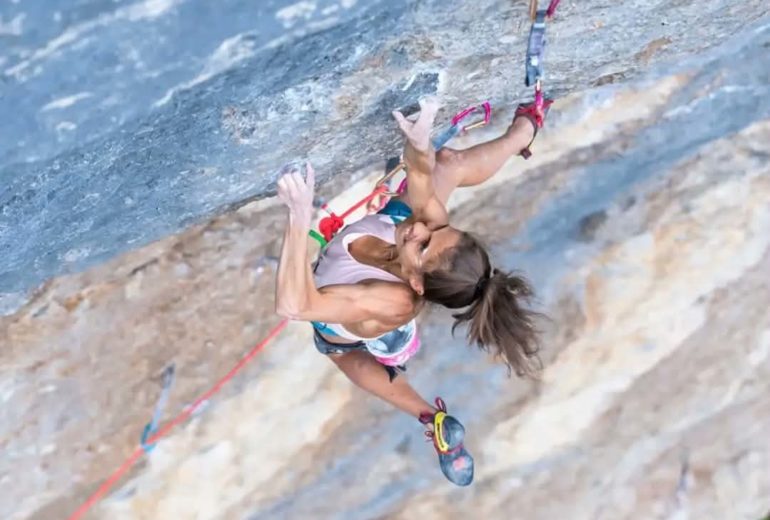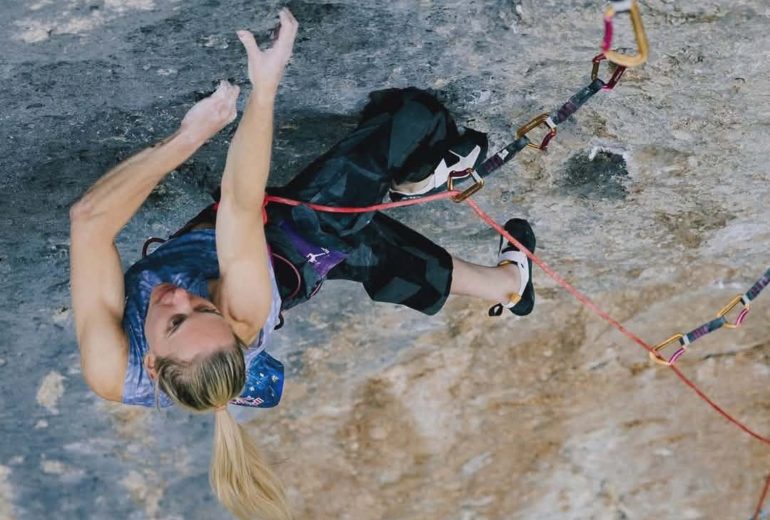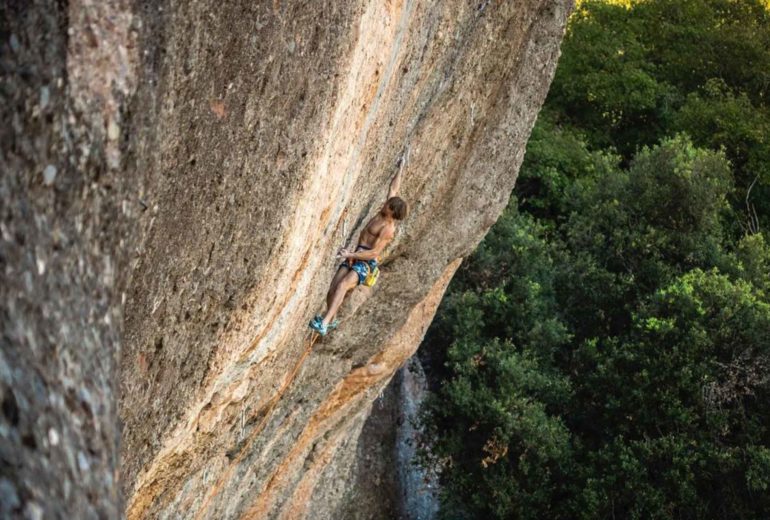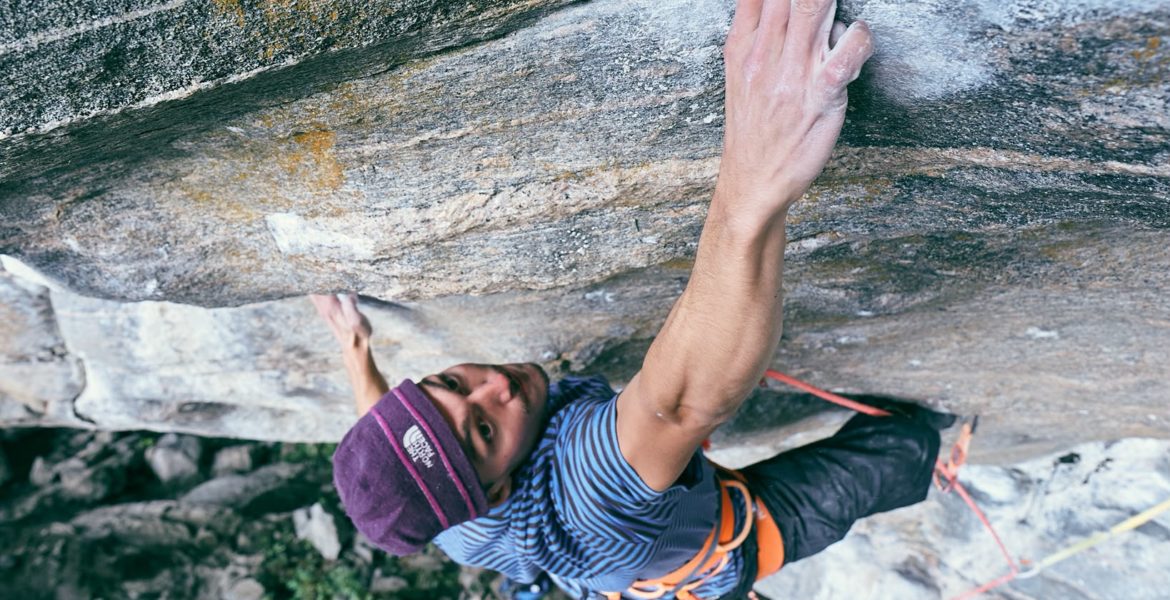
Jules Marchaland vient de réaliser la première ascension de « King Kang », l’un des derniers projets de la mythique grotte de Flatanger. Il propose la cotation de 9b+, sa première réalisation dans ce niveau, un an et demi après avoir ouvert son premier 9b, « Le bruit de l’acid », en avril 2025. La voie n’est autre qu’une variante de sortie directe de « Kangaroo’s limb », un 9a+ équipé et libéré par Adam Ondra en 2013, que Jules avait complété l’an dernier. Plutôt que réaliser une boucle sur la gauche avec des bonnes prises pour terminer la voie, il s’agit de réaliser un énorme jeté final de rampe à rampe ; à réaliser après une « pré-fatigue » en 9a+. Jules avait déjà réussi le mouvement de manière isolée lors de son précédent trip à Flatanger, en septembre 2025. Revenu cette année, il a bouclé la voie en seulement quatre séances, bien plus vite qu’il ne l’imaginait. Il revient en exclusivité sur son ascension.
– Peux tu revenir sur ta découverte du « Kangaroo dyno project », et ton premier séjour pour essayer en septembre 2025 ?
C’est Lucien Martinez qui m’avait parlé en premier de ce projet. J’avais prévu d’aller à Flatanger et il m’avait parlé de ce jeté mythique d’Adam. C’est le genre de mouvement qui m’excite, donc bien sûr en allant là-bas, j’avais hâte de voir à quoi ressemblait ce projet. Après en avoir parlé avec Adam, il m’avait aussi bien vendu l’affaire, pensant que cela me conviendrait bien. Du coup j’y étais allé l’an dernier, mais le jeté me paraissait vraiment dur, même si je l’avais réussi. J’avais commencé à essayer main droite comme Adam, qui avait réussi le mouvement comme cela en 2013, mais j’étais dans l’impasse. Sans faire exprès, je ne sais pourquoi j’ai jeté main gauche, et je me suis rendu compte que c’était vraiment mieux, et j’ai réalisé le mouvement assez rapidement après. Mais la moindre pré-fatigue avec les deux mouvements précédents m’entamait sérieusement, c’était un gros cap à franchir, et je me suis concentré sur la sortie par l’enchainement de la version de gauche, cloué au lit par une cruralgie et une maladie 12 jours sur les 19 de mon trip. Je n’ai pu essayer le jeté que deux séances.
– Peux-tu décrire les difficultés : l’approche en 9a+ marquée par un premier mouvement dynamique difficile, et ensuite décrire ce finish direct avec le crux en lui-même, ce second mouvement dynamique final ?
Tu démarres par l’approche du 8c+ classique « Odin’s eye », qui doit valoir 8b, c’est assez rapide et cool à grimper, ce n’est pas une approche de 50 mètres. Tu arrives à un endroit où tu as 3 bacs, un talon en verrou, un genou, avec un repos confortable avant un mini-dièdre où il faut bien se reposer. C’est un problème pour moi l’optimisation des repos, donc j’étais content de trouver ici ce repos correct. De là tu as la section dure de « Kangaroo’s limb », qui est un pas de bloc avec 3 mouvements de mise en place avant un grand saut dans une arquée plate qui est dément. Jusque là tu as fait 8A bloc, tu dois encore poser un talon dans une arquée, ramener et remonter pour rejoindre les prises du jeté, avec 3 mouvements de mise en position. Le bloc doit valoir environ 8A+ jusqu’à la mise en place du jeté, avec un super caillou.
Concernant le jeté, je trouve cela incotable, plus le temps passe et moins je préfère donner des cotations car je me rends compte n’aime pas trop donner des estimations de difficulté car mon profil est un peu différent des autres et que mon ressenti est rarement identique. Le mouvement à lui seul est autour du 8A+ bloc, peut-être 8A+/B.
– « Le bruit de l’acid » était marqué par un jeté très difficile, le mouvement dynamique extrême devient ta marque de fabrique ? Comment expliques-tu cette aptitude à maîtriser des mouvements si aléatoires, encordé, dans la rési ?
Depuis jeune, j’ai toujours bien aimé sauter, pourtant je ne suis pas tant coordo que ça par rapport aux compétiteurs… mais tirer assez fort et haut sur des prises correctes est quelque chose qui me convient bien et que j’aime bien faire. C’est assez naturel pour un grimpeur d’exploiter ses qualités et points forts, et du coup réaliser des gros jetés encordés est assez chouette, surtout que c’est assez rare en falaise. Mais c’est quand même différent du « Buit de l’acid » marqué par un très grand croisé où tu perds les pieds, alors qu’ici c’est un pur jeté « air time » avec un vrai envol sans rien toucher sur le mur.
– Un mot sur le nom de la voie, le processus et sur la cotation ?
J’ai demandé à Adam si je pouvais garder le « Kangaroo’s dyno » ou si je pouvais changer, il m’a répondu qu’il avait mis 5 minutes à l’équiper et qu’il s’en moquait un peu, tant qu’il y avait un rapport au « Kangaroo » dedans. C’est Roch Oddo qui a trouvé le nom, avec le Kang pour la kangourou, et le King Kang pour quelque chose de brutal, j’ai vite adhéré. Pour la cotation, je ne me sentais pas super légitime à annoncer 9b+ car les grimpeurs de 9b+ dans le monde me semblent bien plus forts que moi. Mais c’est un peu comme une nouvelle ouverture, une nouvelle fenêtre si cela est 9b+, car c’est clairement un bloc avec une corde plus qu’une voie, dans le style, une voie pour les bloqueurs, explosive. Un nouveau spectre dans la cotation (ndlr : avec peut-être « Vasil vasil » et « Excalibur »).
– Juste avant de partir en Norvège, tu as réalisé « L’empreinte de la fouine » à Déversé en hommage à Ben Guigonnet. Peux-tu revenir là-dessus ?
La voie à l’étage de Ben, on avait prévu de l’essayer ensemble, il m’en parlait souvent, me tenait au courant d’où est-ce qu’il en était dans l’ouverture. Son but était de trouver une voie démarrant à l’étage sortant au sommet de la falaise. Ca a été fun de voir que quelque chose marchait. C’était un peu son but, et c’est vraiment bien qu’il ait pu poser cette ligne qui est une king line. Cela me tenait à cœur de libérer cette ligne, j’ai grandi dans les gorges du Loup, c’est là que j’ai appris à grimper, et c’était mon moyen de lui rendre hommage. Des séances remplies d’émotions, je pensais beaucoup à lui, un beau projet de 120 moves avec beaucoup de genoux, pas la grimpe que j’affectionne le plus en termes d’effort mais un super processus.
– Quels sont tes plans pour la fin de l’année ?
Il me reste une semaine à Flatanger et j’essaye un peu « Change », j’espère pouvoir la faire avant de partir, mais à cause de mon pied (ndlr : entorse de l’orteil) , je ne peux pas pousser sur les pieds avec des inversées ou mettre de genou gauche. « Change » marche assez bien. En rentrant, j’aimerais bien mettre une dernière petite salve dans « Biographie » car cet été je suis tombé 3 fois après le crux du haut après l’avoir beaucoup essayée. Ca n’a pas encore payé mais c’est un sympathique processus. J’aimerais aussi rentrer à Grenoble pour me ré-entrainer et commencer à revenir en mode voies courtes et bloc. Quelques voies courtes en Espagne, un peu de bloc dans le Tessin, une visite dans « Excalibur », voilà ce qui me motive.
Avec cette nouvelle croix, Jules continue de progresser dans le haut niveau outdoor et signe son premier 9b+. Si la difficulté venait à être confirmée, il deviendrait le second grimpeur français dans le niveau. Et pour la petite anecdote, cinq jours avant le départ pour la Norvège, Jules s’est fait une entorse au gros orteil. Coup de chance : la blessure ne le gêne que dans certaines positions de griffé de pied… et aucune ne se trouve dans « King Kang » !
Crédit photos : Crédit : Johan Nilsson
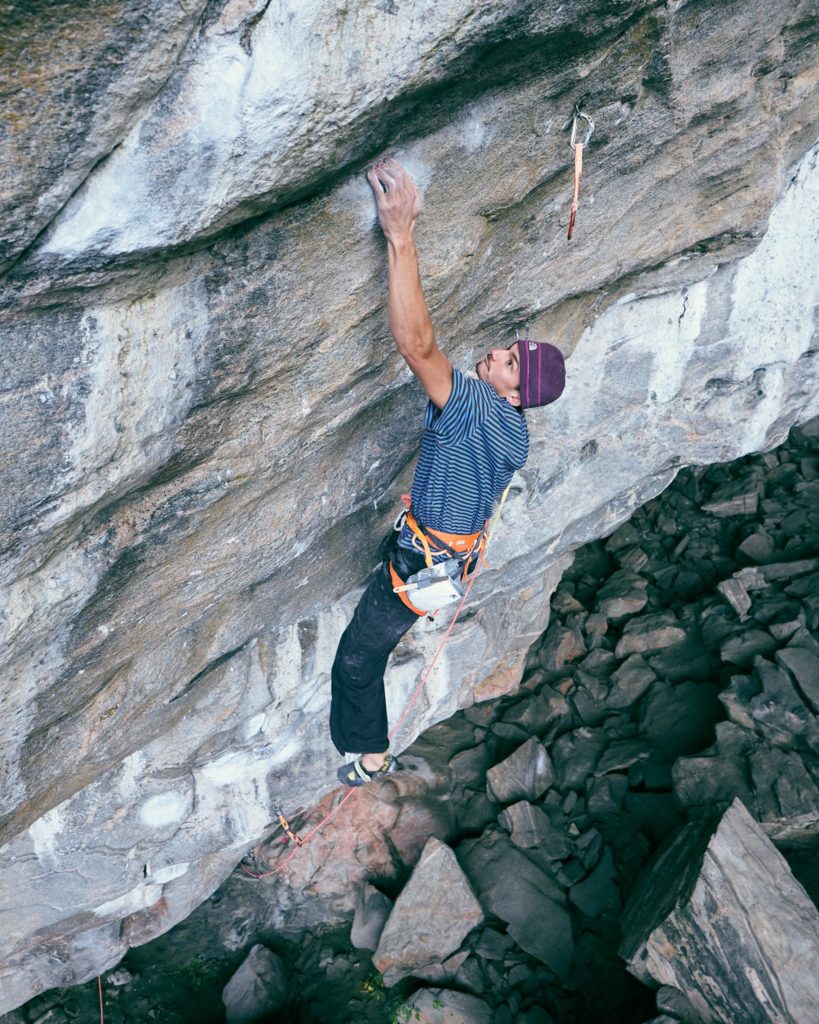
Jules Marchaland has just made the first ascent of “King Kang,” one of the last projects in the legendary Flatanger Cave. He rates it 9b+, his first route at this level, a year and a half after opening his first 9b, “Le bruit de l’acid,” in April 2025. The route is none other than a direct exit variant of “Kangaroo’s Limb,” a 9a+ route bolted and free-climbed by Adam Ondra in 2013, which Jules had completed last year. Rather than making a loop to the left using good holds to finish the route, the move involves a massive final dyno from ledge to ledge—to be executed after a “warm-up” on a 9a+. Jules had already successfully completed the move in isolation during his previous trip to Flatanger in September 2025. Returning this year, he completed the route in just four sessions—much faster than he had imagined. He details his ascent.
– Can you tell us about how you discovered the “Kangaroo Dyno Project” and your first trip there to give it a try in September 2025?
It was Lucien Martinez who first told me about this project. I had planned to go to Flatanger, and he told me about Adam’s legendary jump. That’s the kind of move that gets me excited, so of course, when I went there, I was eager to see what this project was like. After talking it over with Adam, he really sold me on it, thinking it would be a good fit for me. So I went there last year, but the dyno seemed really tough to me, even though I managed to stick it. I’d started by trying it right-handed, like Adam—who’d completed the move that way in 2013—but I’d hit a wall. Without meaning to, and for some reason, I tried it left-handed, and I realized it felt much better; I managed the move fairly quickly after that. But even the slightest bit of fatigue from the two previous moves was really taking its toll on me; it was a major hurdle to overcome, and I focused on getting through the sequence using the left-hand version, while I was bedridden with cruralgia and an illness for 12 out of the 19 days of my trip. I was only able to try the dyno during two sessions.
– Can you describe the difficulties: the 9a+ approach, marked by a difficult dynamic first move, and then describe that direct finish with the crux itself—that final dynamic second move?
You start with the approach from the classic 8c+ “Odin’s Eye,” which must be closer to 8b – it’s a pretty quick and fun climb, not a 50-meter approach. You reach a spot where you have three handholds, a heel hook, and a kneebar, with a comfortable rest before a mini-dihedral where you really need to rest up. Optimizing rests is a challenge for me, so I was happy to find this decent rest here. From there, you face the difficult section of “Kangaroo’s Limb,” which is a bouldering move with three setup moves before a big jump into a flat crimp hold that’s insane. Up to this point, you’ve climbed an 8A boulder problem; you still need to place a heel in the slopy crimp, pull back, and climb up to reach the holds for the dyno, with three positioning moves. The whole boulder problem is probably around 8A+ up to the dyno setup, with a great rock feature.
As for the dyno, I find it impossible to grade. The more time passes, the less I like to assign grades, because I realize I don’t really enjoy estimating difficulty—my approach is a bit different from others’, and my experience of the route rarely matches theirs. The move itself is around 8A+ bouldering, maybe 8A+/B.
– “Le bruit de l’acid” featured a very difficult dyno—is this extreme dynamic movement becoming your trademark? How do you explain this ability to master such unpredictable movements with a rope?
Ever since I was young, I’ve always loved jumping, even though I’m not as coordinated as some of the competitors… but pulling hard and high on solid holds is something that suits me well and that I really enjoy doing. It’s pretty natural for a climber to make the most of their qualities and strengths, and that’s what motivates me—it’s a lot of fun. So pulling off big, roped-up jumps is pretty cool, especially since it’s pretty rare on the rockclimbing game. But it’s still different from “Buit de l’acid,” which features a huge cross-move where you lose your feet, whereas here it’s a pure “air time” move with a real takeoff without touching anything on the wall.
– A quick note about the route name, the process, and the grade?
I asked Adam if I could keep “Kangaroo’s Dyno” or if I could change it, and he replied that it had taken him five minutes to set it up and that he didn’t really care, as long as there was a reference to “Kangaroo” in it. Roch Oddo came up with the name—“Kang” for kangaroo and “King Kang” for something brutal—and I was quickly on board. As for the grade, I didn’t feel entirely justified in calling it 9b+ because 9b+ climbers around the world seem much stronger to me than I am. But it’s a bit like a new opening, a new window if it’s 9b+, because it’s clearly more of a rope-length boulder problem than a route—in style, a route for boulderers, explosive. A new spectrum in the grading system (editor’s note: along with “Vasil vasil” and “Excalibur”).
– Just before leaving for Norway, you climbed “L’empreinte de la fouine” at Déversé as a tribute to Ben Guigonnet. Can you tell us more about that?
Ben’s route is located at Déversé’s “upper level”—we’d planned to try it together; he’d often talk to me about it and how far along he was in the opening. His goal was to find a route starting on the upper level and exiting at the top of the cliff. It was fun to see that something was working out. That was kind of his goal, and it’s really great that he was able to establish this route, which is a king line. It was important to me to free this route—I grew up in the Gorges du Loup, that’s where I learned to climb, and it was my way of paying tribute to him. Those sessions were full of emotion; I thought about him a lot. It was a beautiful project with 120 moves and a lot of kneebar work—not the kind of climb I enjoy the most in terms of effort, but a great process.
– What are your plans for the end of the year?
I have one more week left in Flatanger, and I’m giving “Change” a try. I hope to send it before I leave, but because of my foot (Editor’s note: sprained toe), I can’t push off with my feet on inverted holds or use my left knee. “Change” is going pretty well. When I get back, I’d like to make one last push on “Biographie” because this summer I fell three times past the top crux after trying it a lot. It hasn’t paid off yet, but it’s a fun process. I’d also like to head back to Grenoble to get back into training and start focusing on short routes and bouldering again. A few short routes in Spain, some bouldering in Ticino, a visit to “Excalibur”—that’s what’s motivating me.
With this new send, Jules continues to make progress at the top level of outdoor climbing and has secured his first 9b+. If the difficulty is confirmed, he’ll become the second French climber to reach that level. And here’s a little anecdote: five days before leaving for Norway, Jules sprained his big toe. As luck would have it, the injury only bothers him in certain toe-hooking positions… and none of them are found in “King Kang”!
Photo credit: Johan Nilsson