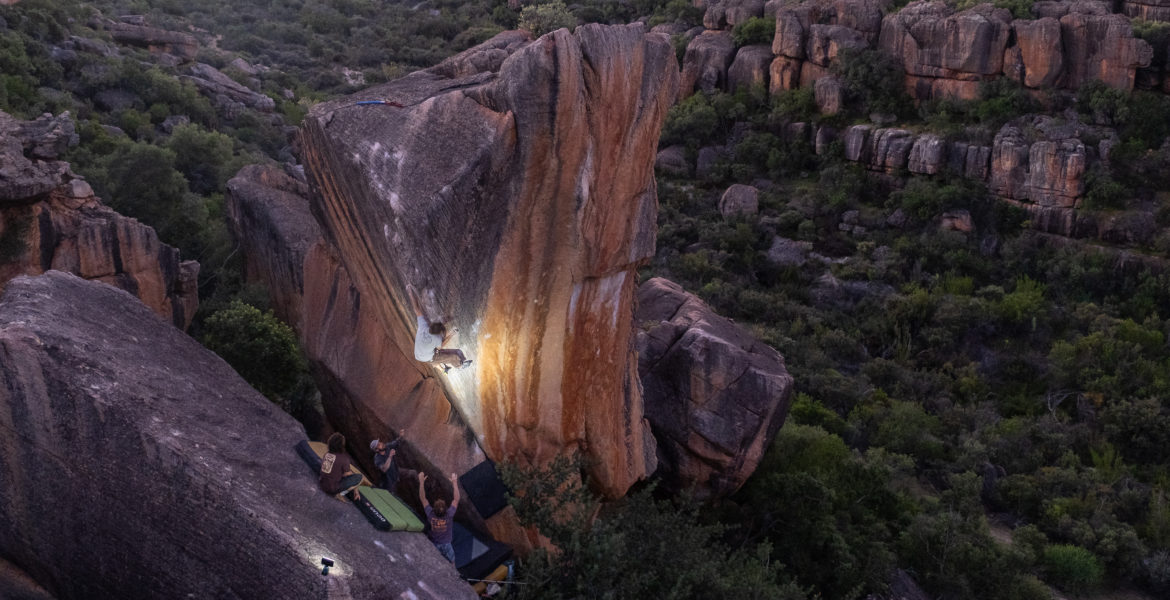
Il y a environ un mois, Rémi Duboz a réussi l’exploit de rétablir au sommet d’un des blocs extrêmes les plus majeurs au monde, l’arête impressionnante de « The Finnish line » (8C) située au secteur The Coop de Rocklands (Afrique du Sud). Cette proue déversante, esthétique et engagée de 8 mètres de haut avait été ouverte en 2017 par le finlandais Nalle Hukkataival, pionnier du bloc mondial, qui avait déjà proposé dans le même style là-bas le highball de « Livin’Large » en 2009, au secteur Champagne. Rémi devient le 3ème français à répéter « The Finnish Line » après Antoine Girard en 2022 et Arthur Ternant l’an dernier. Il nous en dit plus.
Peux-tu décomposer la ligne ?
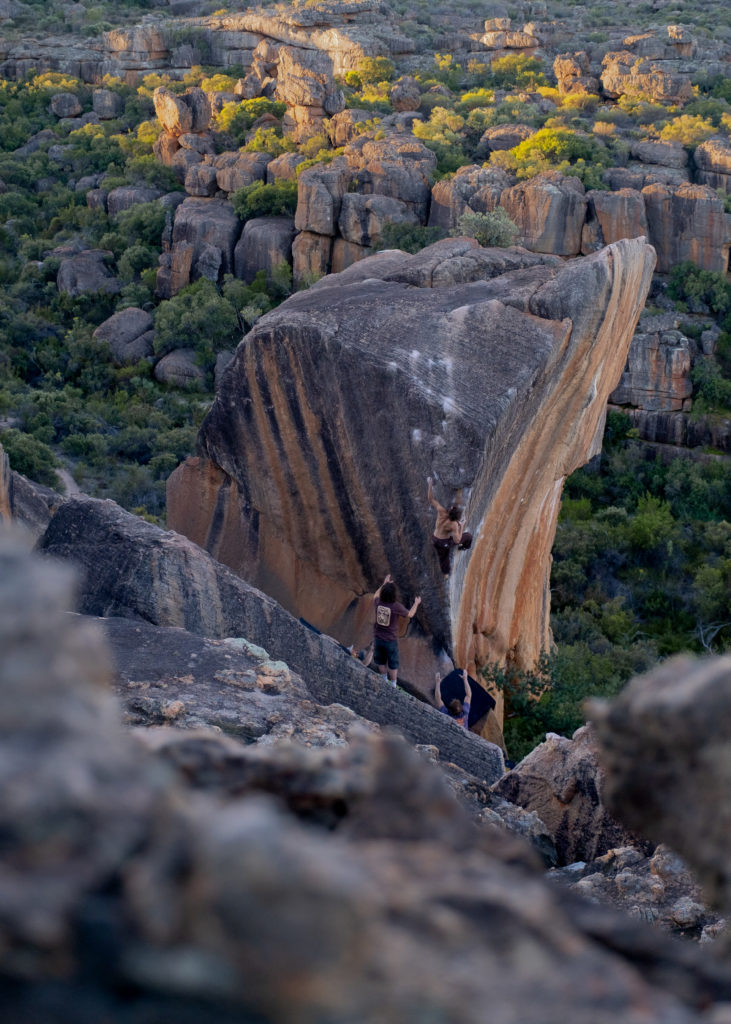
« The Finnish Line se situe sur un gros monolithe d’environ 12 mètres, dans le secteur The Coop à Rocklands. C’est un bloc qui emprunte la face déversante du monolithe. Environ 8 mètres de haut pour Finnish Line, qui se décomposent en :
– une « approche » de 4 mouvements (plus ou moins selon le gabarit), où il est impératif de caler les mains au millimètre sur l’arête à pincer.
– le crux, qui pour moi se décompose en deux parties : tout d’abord le fameux mouvement où l’on passe d’une pince main droite à une pince main gauche assez loin, puis 3 mouvements bien intenses à remonter l’arête, en compression sur des réglettes et en chargeant de petits pieds / talon pour rejoindre une inversée salvatrice.
– S’ensuivent environ 6 mouvements bien moins difficiles, mais où la chute est vraiment à proscrire.
Comment se sont passées les sessions ?
J’ai repéré le bloc à la corde en tout début de séjour parce que j’étais vraiment curieux de savoir si j’étais capable de bouger dedans, et aussi de voir si ma petite blessure au doigt allait m’handicaper ou non. Il se trouve que ça allait plutôt bien !
Si la partie du haut était OK pour moi et ne me faisait pas peur, les mouvements composant le crux me paraissaient vraiment durs. Essayer de sortir le cul du baudrier, prendre des sensations, voir ce qui était envisageable ou non : voilà l’essentiel de cette première séance plutôt courte. Je n’ai même pas essayé la mise en place, faute de crash-pads.
J’ai pu partager ma seconde session avec Keenan Takahashi, qui travaille le bloc régulièrement depuis quelques saisons maintenant. Ce fut un super moment, très enrichissant.
Bilan de la séance : l’approche n’est pas si facile à caler, je ne fais pas la première partie du crux, mais je réussis rapidement la seconde à la corde ainsi que le haut. Y’a du boulot !
Quelques jours après cette session, j’ai vu passer une story d’Ethan Pringle essayant une nouvelle méthode pour la première partie du crux : passer sur la droite de l’arête pour rejoindre la pince main gauche.
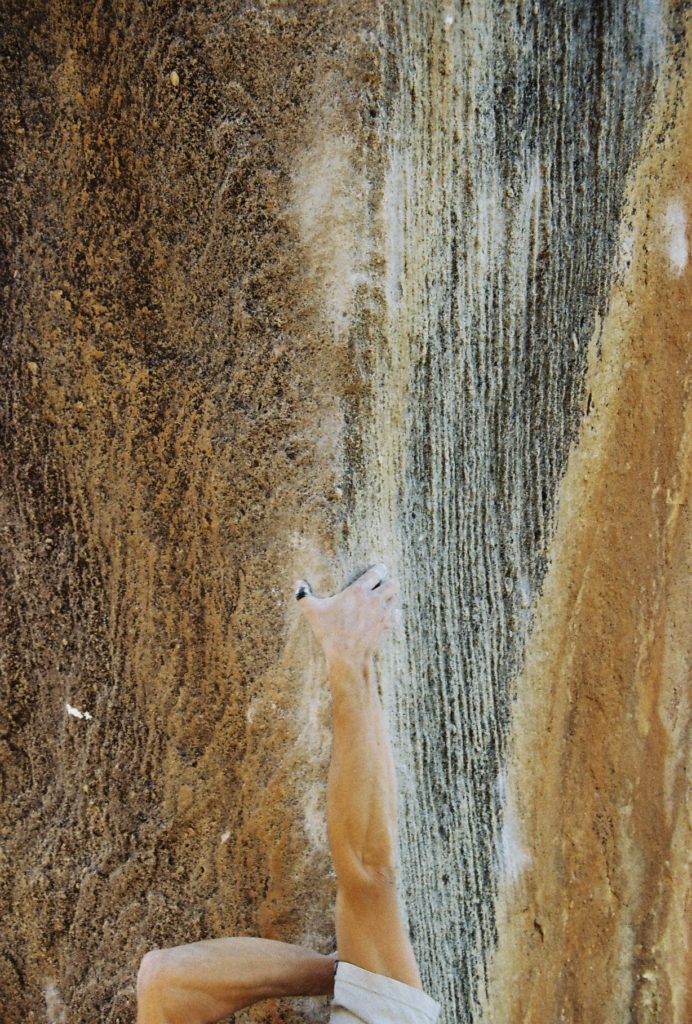
Lors de ma troisième séance dans le bloc, j’ai donc essayé de trouver des calages avec cette possible nouvelle méthode, tout en continuant à essayer la méthode originale. Je sentais que les deux pouvaient me convenir, mais pour l’heure, rien n’aboutissait ! J’ai finalement trouvé mes calages pour faire la nouvelle méthode, qui existait maintenant bel et bien : j’ai su plus tard qu’un Anglais venait de réussir le bloc comme ça quelques jours auparavant. Au lieu de faire un mouvement de main et de pied, la section comprenait pour moi 4 mouvements de mains et 2 mouvements de pieds pour rejoindre la seconde partie du crux. Plus long, plus technique, plus à doigt, mais un poil moins brutal…
Lors de la quatrième séance, j’étais à deux doigts de réussir la première partie du crux dans les deux méthodes. Quel dilemme ! Quelques avancées, et je sentais quelque part au fond de moi que c’était à ma portée. Mais je crois que c’est surtout grâce aux copains, qui y croyaient encore plus que moi, que j’ai compris que je pouvais vraiment le faire.
À ma cinquième séance, après avoir tout recalé à la corde et fait un bon essai dans la méthode originale, je réessaie la nouvelle méthode et tombe à la toute fin du crux, pour rejoindre l’inversée salvatrice.
Flash pump ou trop d’excitation, j’avais qu’à mieux m’échauffer ! Après quelques minutes de re-concentration, je m’élance à la tombée de la nuit pour rejoindre le sommet de cette King Line quelques secondes plus tard. Juste incroyable pour moi de réaliser ce bloc, et si vite d’autant plus. Pour l’anecdote, mon coude a craqué assez fort lors du premier essai ce jour-là. J’ai sans doute eu de la chance de le faire ensuite, parce que le lendemain, je ne pouvais plus grimper !
King Line ?
Oui, parce que ce bloc mêle tout ce que l’on peut rechercher, à mon sens, dans l’escalade : la beauté de la ligne, l’esthétique des mouvements, la difficulté, le toucher du caillou, l’ambiance créée par le cadre et la hauteur. C’est ce genre de ligne qui vous prend, qui vous fait littéralement rêver !
Photos : Clément Davot et Marie Rougier
About a month ago, Rémi Duboz achieved the feat of climbing one of the world’s most extreme boulders: the impressive arete known as “The Finnish Line” (8C), located in the Coop sector of Rocklands (South Africa). This 8-meter-high, overhanging, aesthetic, and challenging line was first climbed in 2017 by Finnish climber Nalle Hukkataival, a pioneer of the global bouldering scene, who had previously established the “Livin’ Large” highball in a similar style in the Champagne sector in 2009. Rémi becomes the third French climber to repeat “The Finnish Line,” following Antoine Girard in 2022 and Arthur Ternant last year. He tells us more.
Can you break down the line?
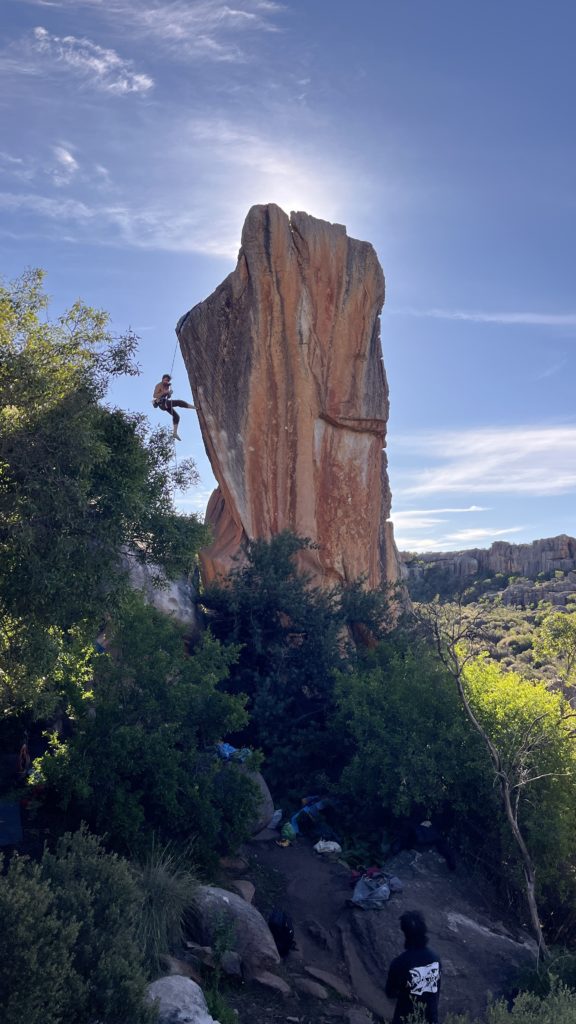
« The Finnish Line is located on a large monolith about 12 meters high, in the The Coop sector at Rocklands. It’s a route that follows the overhanging face of the monolith. “Finnish Line” is about 8 meters high, which breaks down into:
- a 4-move “approach” (more or less depending on your size), where it’s essential to place your hands with millimeter precision on the pinch hold.
- the crux, which for me breaks down into two parts: first, the famous move where you transition from a right-hand pinch to a left-hand pinch quite a distance away, followed by three very intense moves up the arete, using compression on crimps and loading your feet and heels to reach a saving undercling.
- This is followed by about six much less difficult moves, but where a fall is absolutely to be avoided.
How did the sessions go?
I checked out the rope-assisted boulder right at the start of my trip because I was really curious to see if I could make any moves on it, and also to see if my minor finger injury would hold me back or not. It turned out to go pretty well!
While the upper section was fine for me and didn’t scare me, the moves making up the crux seemed really tough. Trying to get my butt out of the harness, getting a feel for it, seeing what was possible and what wasn’t—that was the gist of this first, rather short session. I didn’t even try the approach move, since there were no crash pads.
I was able to share my second session with Keenan Takahashi, who’s been working on this boulder regularly for a few seasons now. It was a great time, very rewarding.
Takeaways from the session: the approach isn’t that easy to nail down; I couldn’t get through the first part of the crux, but I quickly managed the second part on the rope as well as the top. There’s work to be done!
A few days after that session, I saw a story from Ethan Pringle trying a new approach to the first part of the crux: going to the right of the edge to reach the left-hand pinch.
So during my third session in the bouldering area, I tried to find my rhythm with this potential new beta, while continuing to try the original one. I felt that both might work for me, but for the time being, nothing was coming together! I finally found my rhythm for the new method, which was now very much a reality: I later learned that an English climber had just sent the problem that way a few days earlier. Instead of one hand and one foot move, the section involved, for me, four hand moves and two foot moves to reach the second part of the crux. Longer, more technical, more finger-intensive, but just a tad less brutal…
During my fourth session, I was on the verge of completing the first part of the crux using both methods. What a dilemma! I’d made some progress, and deep down I felt it was within my reach. But I think it was mainly thanks to my friends—who believed in me even more than I did—that I realized I could really do it.
On my fifth session, after resetting everything on the rope and making a solid attempt using the original method, I tried the new method again and fell right at the very end of the crux, landing on the saving undercling hold.
Whether it was a flash pump or just too much excitement, I just needed to warm up better! After a few minutes of refocusing, I set off at dusk and reached the summit of this King Line a few seconds later. It was just incredible for me to complete this problem—and so quickly, no less. As a side note, my elbow popped pretty loudly on my first attempt that day. I was probably lucky to have done it right then, because the next day, I couldn’t climb anymore!
King Line?
Yes, because this boulder combines everything you could possibly want in climbing, in my opinion: the beauty of the line, the aesthetics of the moves, the difficulty, the feel of the rock, and the atmosphere created by the setting and the height. It’s the kind of line that grabs you, that literally makes you dream!
Pics: Clément Davot et Marie Rougier